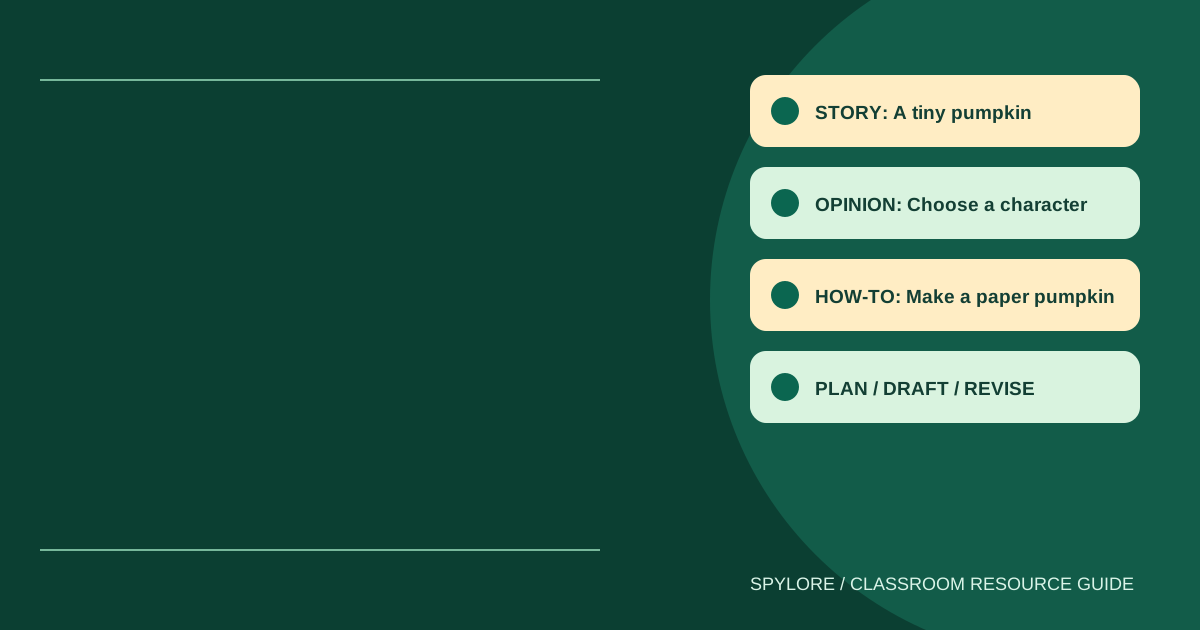
Halloween Writing Prompts: 12 Ideas for Grades 2-4
SpyLore · TPT seller SEO guide
Halloween Writing Prompts: 12 Ideas for Grades 2-4
Use 12 Halloween writing prompts for grades 2-4 with planning steps, a model paragraph, revision questions, and alternatives for fall classrooms.
These Halloween writing prompts help students in grades 2-4 plan a story, support an opinion, or explain a process. Choose one writing purpose per lesson and teach that purpose explicitly. A seasonal picture can start a conversation, but children also need time to organize, draft, and revise.
Keep the mood playful rather than frightening. Offer a fall alternative for students whose families or schools do not celebrate Halloween. Students can write about an unusual pumpkin, a windy walk, or a classroom celebration without describing personal beliefs or family spending.
12 prompts grouped by writing purpose
Story prompts
- A tiny pumpkin rolls into your classroom. What surprising job does it want?
- Your paper costume comes to life for ten minutes. What does it help you do?
- A friendly ghost is afraid of the dark. How do two friends help?
- You discover a door inside a giant pumpkin. What happens when you knock?
Ask students to include a character, a problem, two attempts to solve it, and an ending. A list of spooky objects does not yet form a story. Invite students to explain why their character makes an important choice.
Opinion prompts
- Should a classroom celebration include games, crafts, or both? Give two reasons.
- Is a funny costume or a clever costume more interesting? Explain with examples.
- Which would make a better story character: a talking cat or a dancing pumpkin?
- Should students design decorations together or individually? Support your choice.
Use a simple plan: opinion, reason one, reason two, closing sentence. Children can disagree respectfully; the assessment should focus on their reasons and organization, not their preferred celebration.
How-to and descriptive prompts
- Explain how to make a paper pumpkin using only classroom supplies.
- Describe a mysterious garden using three senses without making it scary.
- Teach a new student how to play a fall matching game.
- Describe an autumn scene so a partner could draw it from your words.
For a how-to task, ask a partner to follow the directions. Missing steps become easier to notice when someone actually tries them. For descriptive writing, encourage precise nouns and details instead of requiring a fixed number of adjectives.
A 35-minute lesson teachers can repeat
Spend five minutes discussing the prompt and modeling a plan. Allow five minutes for oral rehearsal with a partner, fifteen for drafting, five for revision, and five for sharing. Adjust the drafting period for your learners; a complete short piece is more useful than an unfinished long one.
Provide the same prompt in two formats: a page with picture boxes and sentence starters, and a page with an open planning space. Support students with a word bank they can understand. Allow dictation or speech-to-text where appropriate, while retaining the same writing goal.
Model paragraph and revision
Prompt: “Which would make a better story character: a talking cat or a dancing pumpkin?”
“A talking cat would make a good story character. First, it could warn the children when their kite gets stuck. Next, it could ask the neighbor for a ladder. Its words would help the characters solve their problem.”
This original model gives an opinion and two related examples. Discuss how the final sentence connects them. Then revise a vague sentence such as “It would be good” into a specific explanation. Students should understand the reason for a revision before they copy it.
Check the writing without overcorrecting
- Purpose: does the piece answer the chosen prompt?
- Organization: can the reader follow the events or reasons?
- Detail: is there at least one specific example or action?
- Editing: has the student checked the conventions taught so far?
Select one revision target per child. Correcting every sentence can crowd out the main lesson. Save an initial draft and a revised draft to show what changed.
What a teacher seller should include
A useful pack includes all twelve prompts, differentiated planners, a model, a student revision checklist, and a brief teacher guide. State the intended grades and avoid claiming every page fits every learner. Include an ink-friendly version and show enough preview pages for buyers to assess the writing space.
Try a descriptive title such as “Halloween Writing Prompts Grades 2-4 | Story and Opinion.” For more listing guidance, read how to write TPT descriptions. Pair this pack with grade 2 Halloween math centers only when the combined grade range is clear.
Research context
Google Trends showed rising US interest in the broad Halloween activities term during September 2026. The writing angle is an editorial choice to serve teachers; the exact prompt keyword was not measured. Relative interest is not evidence of purchase intent or a guaranteed Google position.
FAQ
How long should students write?
Set the expectation around a complete idea. Some learners may produce several connected sentences; others may develop multiple paragraphs.
Can I use these prompts in a school that avoids Halloween?
Yes. Replace the cat, ghost, or costume with an autumn animal, windy day, or paper craft while keeping the writing purpose.
Should every student use the model wording?
No. Use the model to discuss structure, then ask learners to develop their own ideas and examples.