Fall Literacy Centers for Kindergarten: 5 Simple Stations
SpyLore · TPT seller SEO guide
Fall Literacy Centers for Kindergarten: 5 Simple Stations
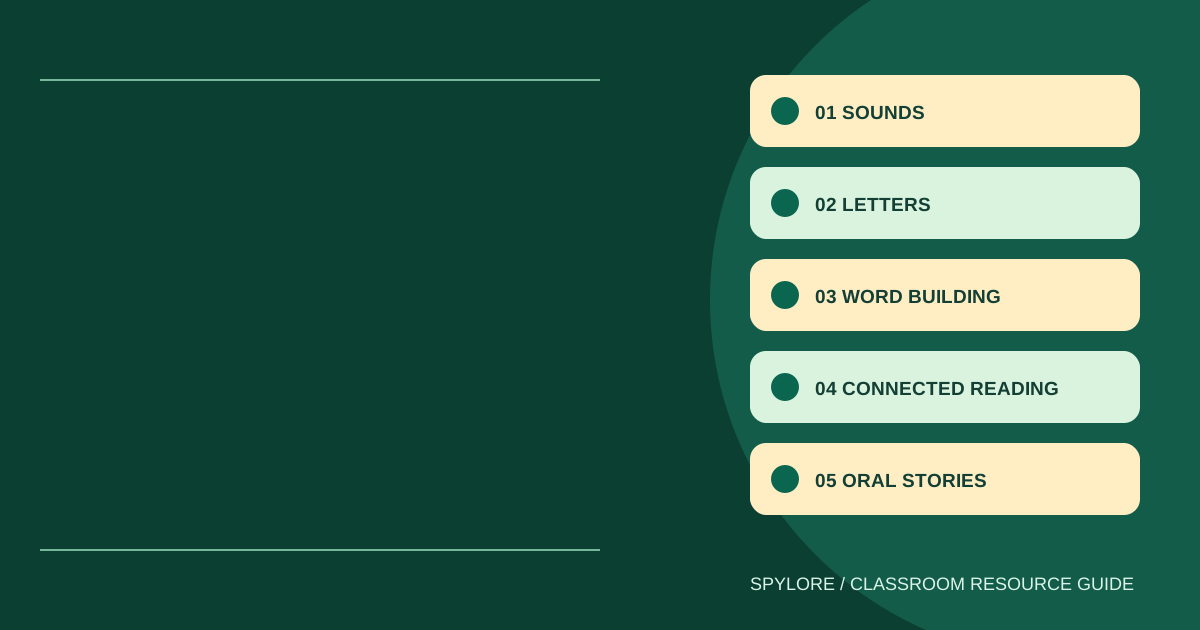
Build five kindergarten fall literacy centers with sound practice, letter matching, decoding, oral language, and a practical teacher checklist.
Fall literacy centers for kindergarten should practice skills children have already learned, with autumn imagery providing interest rather than extra decoding difficulty. These five stations separate oral sound work, letter knowledge, word building, connected reading, and storytelling. Teachers can choose the stations that fit their current instruction instead of introducing everything at once.
Do not assume a word is beginner-friendly because its picture is familiar. “Leaf,” “acorn,” and “pumpkin” contain patterns that may be beyond a child's current decoding knowledge. Use these words in oral vocabulary work, and select printed words according to the sound-spelling patterns you have taught.
1. Listen for the first sound
Show a picture of a sun, sock, map, or mouse. Say the name aloud, then ask the child to repeat it and identify the first sound. Sort the pictures into /s/ and /m/ groups. Use teacher-confirmed picture names so an image does not accidentally introduce a different answer.
This is an oral sound task. Children do not need to read the picture label. Add letters only when the sound-letter connections are familiar. A support version uses two pictures; an extension asks learners to suggest another word beginning with the same sound.
2. Match leaf letters
Place uppercase and lowercase letters on paper leaves. Students pair M with m, S with s, and the other letters from your taught set. Ask students to name the letter and give its practiced sound where appropriate.
Limit the first set to four or six pairs. A large pile can turn a short retrieval task into a visual search exercise. Include a self-check strip that shows the correct pairs; teach students how to use it after they attempt the match.
3. Build and change a word
Use letter tiles for mat, sat, and sit if those spellings have been taught. Say “mat,” help children segment its sounds, and let them build it. Ask them to change one letter to make “sat,” then change another to make “sit.” Read each word after the change.
Use plain letter tiles on a fall-colored mat. The design does not need to force seasonal vocabulary into a decoding task. Provide a teacher model and an answer strip, and watch for children swapping tiles without rereading the word.
4. Read a short connected text
Use a teacher-selected text containing known spelling patterns and explicitly taught irregular words. If every element has been taught, a short example might be “Sam sat. Sam sat on a mat.” Ask who sat and where. The purpose is to connect accurate word reading with meaning.
An adult-supported station is appropriate when children cannot yet read independently. Avoid asking them to guess unfamiliar words from autumn pictures. A useful extension is to reread with smoother phrasing, rather than racing another child.
5. Tell a fall sequence
Provide three original pictures: a child finds a leaf, compares it with another, and draws both. Students retell the sequence using first, next, and last. Partners can ask one clarifying question, such as “What was different about the leaves?”
This station develops oral language without requiring advanced handwriting. Children who are ready can dictate or write a caption. Invite observations about local weather and plants; autumn does not look the same in every region.
Plan the rotation and assess one skill
Begin with two independent stations and one adult-supported task. Model the routine before increasing the number of stations. A five-minute center with a clear goal can be more manageable than a long activity with several unrelated directions.
- Label each tray with its purpose and a picture of the finished task.
- Use taught examples for the independent version.
- Offer a smaller card set for learners who need less visual load.
- Record one observation: sound identification, letter pairing, decoding, or retelling.
- Reteach the observed difficulty before adding more cards.
Resource checklist for TPT creators
Include the taught-pattern assumptions, picture-name key, letter cards, word lists, station directions, and teacher observation sheet. Preview the actual cards at a readable size. Describe the resource as practice, and avoid claiming it is a complete phonics curriculum or an evidence-tested intervention.
The IES foundational reading guide recommends instruction in sound-letter links, word decoding, oral language, and connected text. Those recommendations inform the skill choices here; these particular seasonal activities have not been separately evaluated by IES.
Why publish this guide now?
The broad US query “fall activities” increased from 27 to 55 between the weeks beginning September 6 and September 20, 2026, in this Google Trends comparison. Kindergarten literacy is a narrower classroom use, not a measured keyword winner. Validate exact buyer language with TPT keyword research before designing a paid pack.
FAQ
Must all five centers be independent?
No. Keep decoding or connected reading adult-supported when learners still need modeling and feedback.
Can I include pumpkin vocabulary?
Yes, in oral language and supported reading. Independent decoding words should match the spelling patterns children know.
What can I use for a science connection?
Try the observation and sequencing ideas in pumpkin life cycle activities.