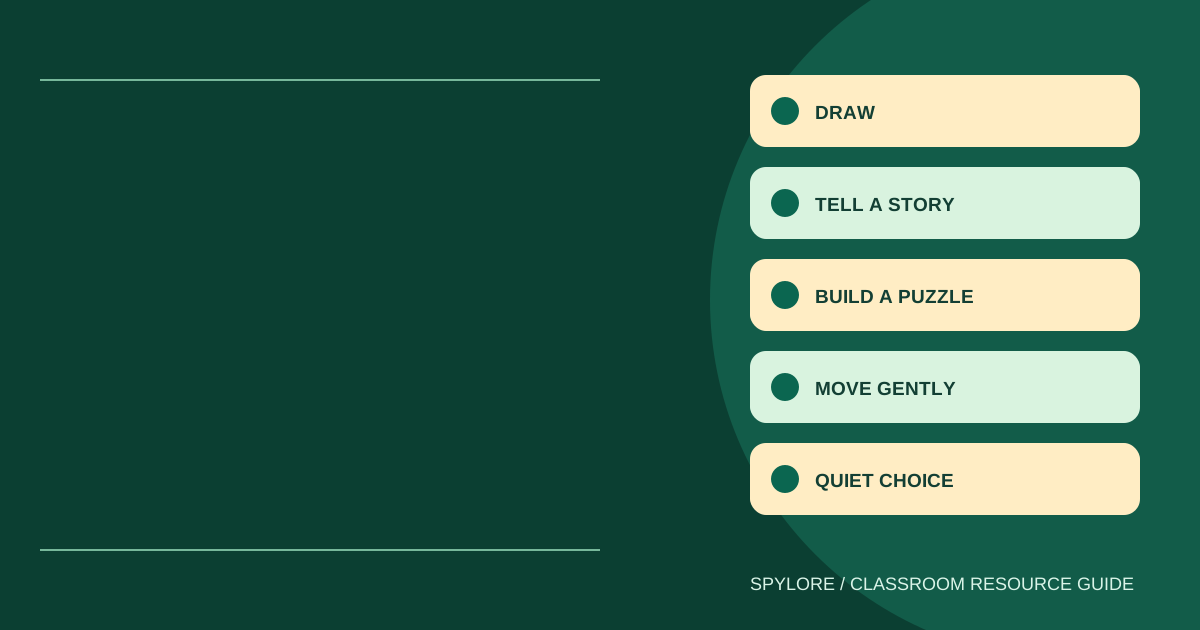
Rainy Day Classroom Activities: 8 Low-Prep Ideas
SpyLore · TPT seller SEO guide
Rainy Day Classroom Activities: 8 Low-Prep Ideas
Plan indoor recess with eight low-prep classroom activities, seated options, a 20-minute routine, and a practical checklist for teacher resources.
Rainy day classroom activities are easier to manage when students have a few clear choices, a noise expectation, and a predictable finish. These eight ideas use everyday supplies and work as indoor recess choices or short transition activities. Choose the options that fit your space and students instead of running every activity at once.
Indoor recess is also a break. Offer genuine choices and opportunities for social interaction rather than turning every minute into a worksheet assignment. If your school has specific movement or supervision rules, build the choice board around those rules.
1. Draw from three shapes
Write circle, triangle, and rectangle on the board. Students create a picture containing all three, then explain their drawing to a partner. Provide shape stencils or pre-drawn shapes for children who want them.
This needs paper and pencils, not printed worksheets. A child can make a robot while another makes a garden. Avoid judging the task by who draws most realistically; the constraint is using the three shapes.
2. Build a paper tower
Give each small group five sheets of scrap paper. Ask them to build a freestanding tower on a desk without climbing or attaching it to furniture. Allow folding and rolling. State in advance whether tape is permitted.
After five minutes, ask which change made the tower more stable. Compare designs without awarding a prize for height. Students can rebuild once using an idea they observed in another group.
3. Partner picture descriptions
One child draws a simple picture privately and describes it while a partner draws from the description. “Put a small circle above the square” is more helpful than “Draw it like mine.” Compare the pictures and switch roles.
Use a shared picture reference or adult support for learners who need communication adaptations. The goal is clear description and listening, not a perfect copy.
4. A cooperative story circle
Start with “A tiny umbrella appeared on our classroom shelf.” Each child adds one sentence. A student may pass, draw an idea, or contribute with a partner. End the story after one round so it has a manageable length.
Before beginning, agree that the story should be school-appropriate and kind. If the group is large, create several small circles rather than making children wait through thirty turns.
5. Find the sorting rule
Sort ordinary cards into two groups using a hidden rule: curved edges versus straight edges, or objects used indoors versus outdoors. Students suggest the rule and test it with another card. Accept a different explanation if it correctly fits every example.
For a simpler version, name the rule before children sort. For an extension, let pairs create a new rule and invite another pair to investigate it.
6. Mirror movements
Partners face each other with comfortable personal space. One slowly moves their hands or shoulders while the other mirrors them. Switch leaders after one minute. Offer the same task seated, and keep all movements gentle and within each child's comfortable range.
Use this where supervision and classroom space permit. It requires neither running nor moving desks. Children can also lead with facial expressions or hand shapes.
7. Create a tabletop puzzle
Students draw a picture on paper and cut it into a small number of pieces with approved scissors. A partner reassembles it. Provide pre-cut pieces or an uncut drawing option where appropriate.
Agree on a piece limit so cleanup stays realistic. Store each puzzle in an envelope labeled by its creator, or photograph the completed puzzle for a reference image.
8. Quiet choice corner
Offer books, drawing paper, and familiar puzzles. Present this as a normal choice rather than a consequence for students who do not join a group. Let children change activities at an agreed point so transitions remain predictable.
A calm option is particularly useful when the rest of the room contains conversation and movement. It does not need elaborate equipment or a themed printable pack.
A repeatable 20-minute routine
Spend two minutes naming the choices and rules, twelve minutes playing, three minutes cleaning up, and three minutes reflecting. Ask each student to name one useful strategy or enjoyable moment. Use a visual timer if it helps students anticipate the finish.
Choose three or four activities for the day: one social, one creative, one gentle movement option, and one quiet choice. Check walking routes before starting. Keep supplies in labeled trays so students can return them without a long queue.
What to include in a teacher resource
A useful indoor recess pack can contain editable choice cards, illustrated directions, a supply list, seated adaptations, and cleanup labels. Explain what teachers must supply and which tasks require adult supervision. Avoid describing every activity as suitable for every classroom.
Try a focused keyword such as “indoor recess choice board elementary,” but validate it before using it as a product target. The long-tail keyword guide explains how to narrow a broad phrase without adding irrelevant terms.
The Google Trends signal
“Rainy day activities for kids” appeared in rising related queries in this US Google Trends comparison: +350% under Halloween activities and +1,500% under fall activities when checked September 30, 2026. These are related-query changes in that report, not measured classroom keyword volumes. The classroom adaptation here is an editorial choice.
FAQ
Are these only for rainy weather?
No. They can also support indoor breaks when outdoor space is unavailable.
What can I offer without printing?
Shape drawing, storytelling, mirror movements, and a book corner can use existing classroom materials.
Can I make the choices seasonal?
Yes. Try autumn story starters or pumpkin shapes. For a more structured lesson, see Halloween writing prompts.