TPT AI Ban 2026: What Sellers Should Know and Do
Teachers Pay Teachers plans to ban AI-generated resources. See what is confirmed, what to verify, and how to audit your TPT listings with a free checklist.
Teachers Pay Teachers plans to ban AI-generated teaching resources, according to Chalkbeat's October 15, 2026 reporting. For sellers, the immediate job is to understand the announcement, check the applicable written rules, and review the content buyers receive. A headline alone cannot settle every question about a particular worksheet, image, or editing tool.
This guide separates the reported announcement from our own practical review process. Sources were checked on October 18, 2026. We have not independently interviewed TPT or obtained a complete, scope-specific implementation timetable for the announced AI policy.
Start with our free TPT resource review checklist. It is an editable planning document for your own review, not a TPT certification or a substitute for the platform's rules.
Is Teachers Pay Teachers banning AI-generated resources?
Chalkbeat reports that TPT intends to ban AI-generated classroom resources. The announcement followed a seller town hall. In a statement to the publication, a TPT spokesperson described an emphasis on educators' expertise and work to improve identification and removal of AI-generated material.
That establishes a reported direction for the marketplace. It does not, by itself, provide an effective date for every seller or resolve the treatment of every tool and asset. Read the complete announcement and any direct notice in your seller account before making decisions about a specific listing.
For an existing baseline, TPT's Seller Guidelines require seller-created or seller-designed work, accurate descriptions, complete resources, and working access. Those responsibilities matter while sellers seek further clarification about AI.
What is confirmed, and what still needs checking?
Keep three different items in your notes: a reported announcement, a published requirement, and your interpretation of how that requirement applies. Mixing them together makes it difficult to explain why you changed a product later.
The reported plan to restrict AI-generated resources is the news. The existing seller and content guidelines are published requirements. The audit below is SpyLore's suggested workflow. Completing it does not establish that TPT accepts a resource.
Before treating an online recap as a complete TPT AI policy 2026 guide, look for written answers to these questions:
- Which parts of a product or listing are covered, including the resource file, artwork, cover, preview, and description?
- What does TPT mean by AI-generated, and how does it treat assisted editing or accessibility features?
- What is the treatment of existing products and third-party assets purchased under a license?
- What dates, notices, and response procedures apply to your account?
- Where can a seller request clarification or challenge a mistaken decision?
These are questions to verify, not claims that particular exceptions or procedures exist. Save the source URL, the wording relevant to your situation, and the date you reviewed it. A post that says a tool is allowed should point to the rule that supports that statement.
Why teacher expertise matters to buyers
The useful business question is what makes a resource dependable in a classroom. A teacher needs to know whether the directions make sense, the practice matches the intended skill, and the answer key supports the activity.
TPT's own 2026 back-to-school survey describes educators' preference for materials created by real educators over purely AI-generated content. The survey also discusses comfort with human review of AI-assisted material. Those findings describe respondents' attitudes; they do not establish permission to sell a particular AI-assisted product.
You can make expertise visible through concrete choices: explain why the task sequence works, provide a meaningful sample, and show the support a teacher receives. A broad claim such as “high quality” tells buyers less than a preview that shows the actual directions, response space, and answer key.
A 30-minute review for an existing TPT listing
Use the time blocks below as a first pass on one product. A long unit, a large bundle, or uncertain asset history will need more time. Start with the listings that contain material you cannot confidently trace, then review your most-used resources.
1. Record what the listing actually contains
Spend the first five minutes opening the product file, cover, preview, answer key, and teacher instructions. Write down the current version and where the editable originals are stored. Include linked files that a buyer must open elsewhere.
Record how each component was created and where outside assets came from. If you do not know the origin of an image, mark it as unknown. An empty evidence field is more useful than an unsupported assumption that an asset must be acceptable.
2. Check the learning task and answers
Use the next five minutes to complete a sample task as a learner would. Work through the answer rather than relying on the key. For a fraction activity, check that the picture represents the fraction in the question and that the explanation matches both.
Look for missing labels, unclear directions, contradictory examples, or a question with more than one defensible answer. Separate corrections needed for instructional accuracy from questions about the production process. Both deserve attention, but they require different evidence.
3. Trace artwork, text, and other assets
Review the origin of images, passages, fonts, photographs, audio, and templates. Keep receipts and the terms that apply to your intended use. If an asset provider's description is unclear, ask a specific question and retain the answer.
A commercial-use license and a marketplace's content rules answer different questions. Having a receipt does not establish that an asset satisfies an AI restriction. Likewise, a marketplace rule does not establish that you hold the necessary rights to someone else's work.
4. Compare the listing with the delivered files
Check whether the title, description, cover, and preview accurately describe the version a buyer will download. Confirm page counts, grade guidance, formats, included answers, and required software. Remove claims you cannot substantiate, including authorship or AI-related claims.
For a systematic pass, use the SpyLore TPT listing optimization checklist. Its purpose is to help organize a review of the buyer experience; a completed checklist is not marketplace approval.
5. Test the buyer's route through the resource
Open the exported PDF, follow the instructions, and test required links with the access level a buyer is expected to have. Print a sample page if printing is part of the product promise. Check the reading order, contrast, and whether directions remain understandable without color alone.
TPT's Content Guidelines and Seller Guidelines provide the official starting points for content and delivery requirements. Use those pages to check your own delivery arrangement instead of assuming that a working link on your account will work for a buyer.
6. Assign a clear next action
Finish with one decision for each concern: correct a documented error, replace an asset after verifying its requirements, ask TPT a precise question, or continue a deeper review. Set a review date and record the person responsible.
For example, “check AI policy” is too vague to finish. “Ask whether the named illustration in this product falls within the published restriction, with its origin documented” gives you a question that someone can answer. Keep existing customer access and applicable marketplace requirements in mind when planning any changes.
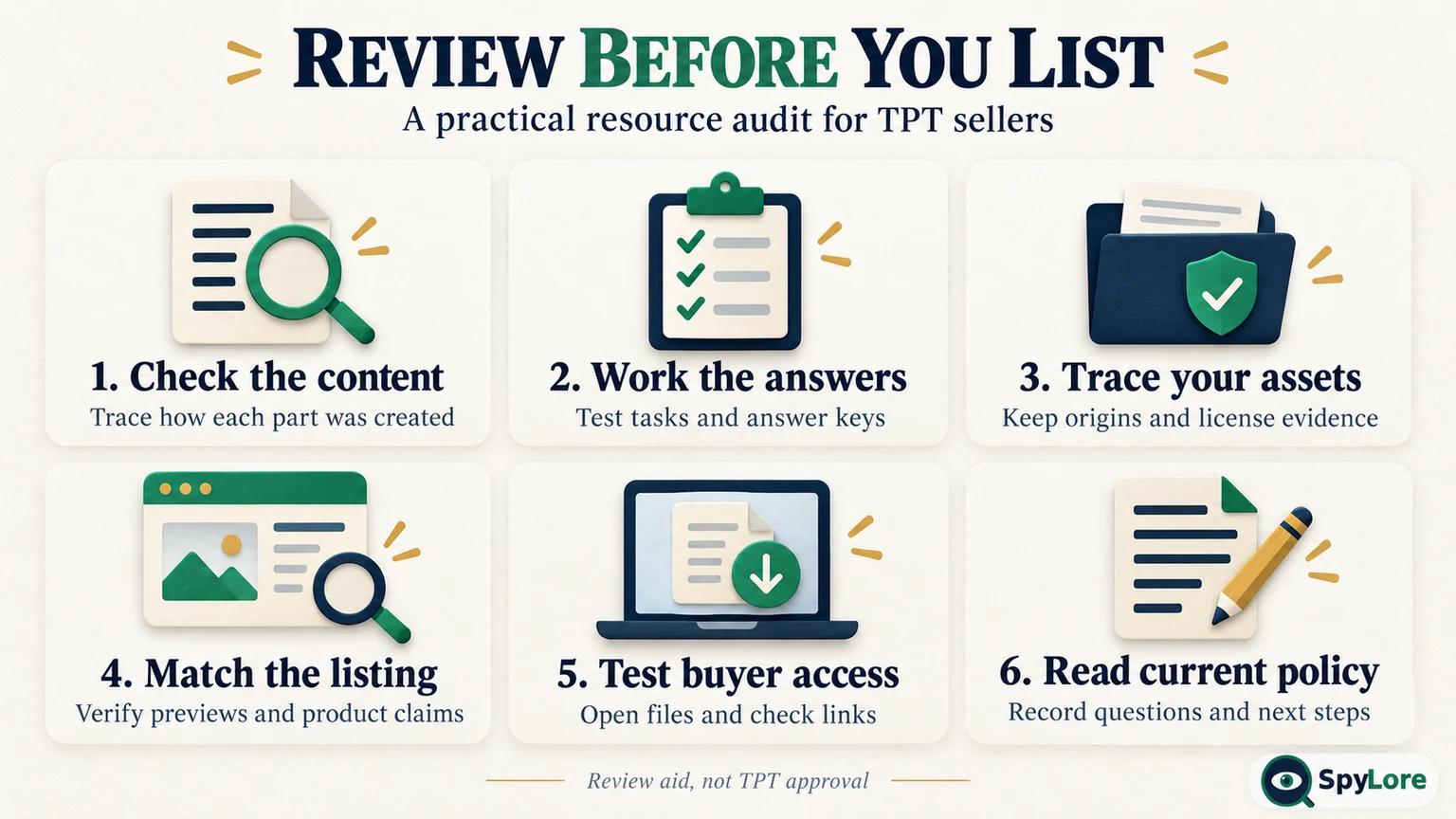
Image note: This is an AI-generated editorial checklist illustration for this blog. It is not a TPT approval badge or a recommendation to upload AI-generated images to TPT.
The SpyLore newsletter
Useful seller news. Straight to your inbox.
A weekly email with new TPT seller guides, marketplace updates, and practical ideas. Free to join.
Improve TPT SEO with specific, supportable claims
After reviewing the product, align the listing with what it genuinely delivers. Useful TPT SEO starts with a clear match between a buyer's search and the resource's purpose. Adding policy keywords to an unrelated product does not make the product more relevant.
For a seller-authored fraction activity, a descriptive title might be “Equivalent Fractions Task Cards for Grade 3 — Visual Models and Answer Key.” Use it only if those details match the actual product. Avoid adding “AI-free,” “teacher-tested,” or a standards claim unless you can support it.
Our TPT keyword research guide explains how to choose a focused phrase. The SpyLore keyword research tool can support research into search terms. Research data does not establish that a resource meets a marketplace policy.
Then make the preview demonstrate the promise. Show an actual task and a useful section of the teacher guidance. In the description, explain what is included and what preparation is required. The TPT product description guide can help you organize those details without making the listing longer than it needs to be.
Keep AI policy and seller exclusivity separate
TPT has also announced changes to its seller membership program. Its official Exclusive Seller announcement explains the transition and distribution commitments for participating sellers. Check the terms and dates that apply to your account directly.
An exclusivity decision concerns where you distribute eligible resources. An AI-content decision concerns what a resource contains and how it was made. Neither decision settles the other. Maintain separate notes so a membership deadline is not mistaken for an AI-policy deadline.
What to do next
Choose one product, complete the first review, and identify the questions that still need evidence. Repeat the process across your catalog with a consistent record. Keep a version history so you can explain what changed and why.
Download the free resource review checklist, or use the editable review log to track multiple listings. Both are original SpyLore planning aids, available without an account.
If you need a broader listing workflow after resolving the content questions, start with our TPT SEO guide and listing optimization workflow. SpyLore can help organize research and presentation; TPT remains the source for decisions about its own marketplace rules.
Sources and editorial notes
This is an original SpyLore explainer and seller workflow, informed by the October 15 Chalkbeat report. The reported announcement is attributed to Chalkbeat. The review steps and examples are our own recommendations, not a transcript of the seller town hall.
Official reference pages checked on October 18, 2026: TPT Seller Guidelines, TPT Content Guidelines, TPT's back-to-school survey, and the Exclusive Seller announcement. Recheck those sources and your account notices before acting on a policy change.
SpyLore is independent of TPT and Chalkbeat. The branded illustrations are for this website's editorial article. They do not depict an official notice, establish classroom testing, or imply endorsement.
Frequently Asked Questions
Is the TPT AI ban already in effect for every seller?
The October 15, 2026 Chalkbeat report describes TPT's plan to ban AI-generated resources. This article does not establish a universal effective date. Check TPT's current written policy and any direct notice for the timeline that applies to your account.
Can I use AI-generated clip art if I bought a commercial license?
A license addresses the permissions its provider grants. TPT's marketplace rules are a separate requirement. Verify both the asset's origin and the applicable TPT rule; this guide cannot establish that a licensed AI-generated image is permitted.
Does human editing automatically make an AI-generated resource acceptable?
Do not assume that editing changes how TPT classifies a resource. Review the platform's actual definition and ask about your specific situation if the wording is unclear. Human review is valuable for accuracy, but it does not establish policy acceptance.
Does this announcement mean teachers cannot teach about artificial intelligence?
The reported announcement concerns AI-generated resources. A lesson's subject and the way it was created are different questions. Assess the actual content and the current rules rather than treating any mention of AI as evidence about its authorship.
Can SpyLore certify that my resource follows TPT's AI policy?
No. SpyLore's research tools and review checklists can help organize your work, but they do not certify acceptance under TPT's rules. Use the official policy and direct clarification from TPT for unresolved eligibility questions.